
From Wrestling to Surrender: What Happens When We Stop Fighting the Call to Serve - Letters to the Housed by Paul Asplund
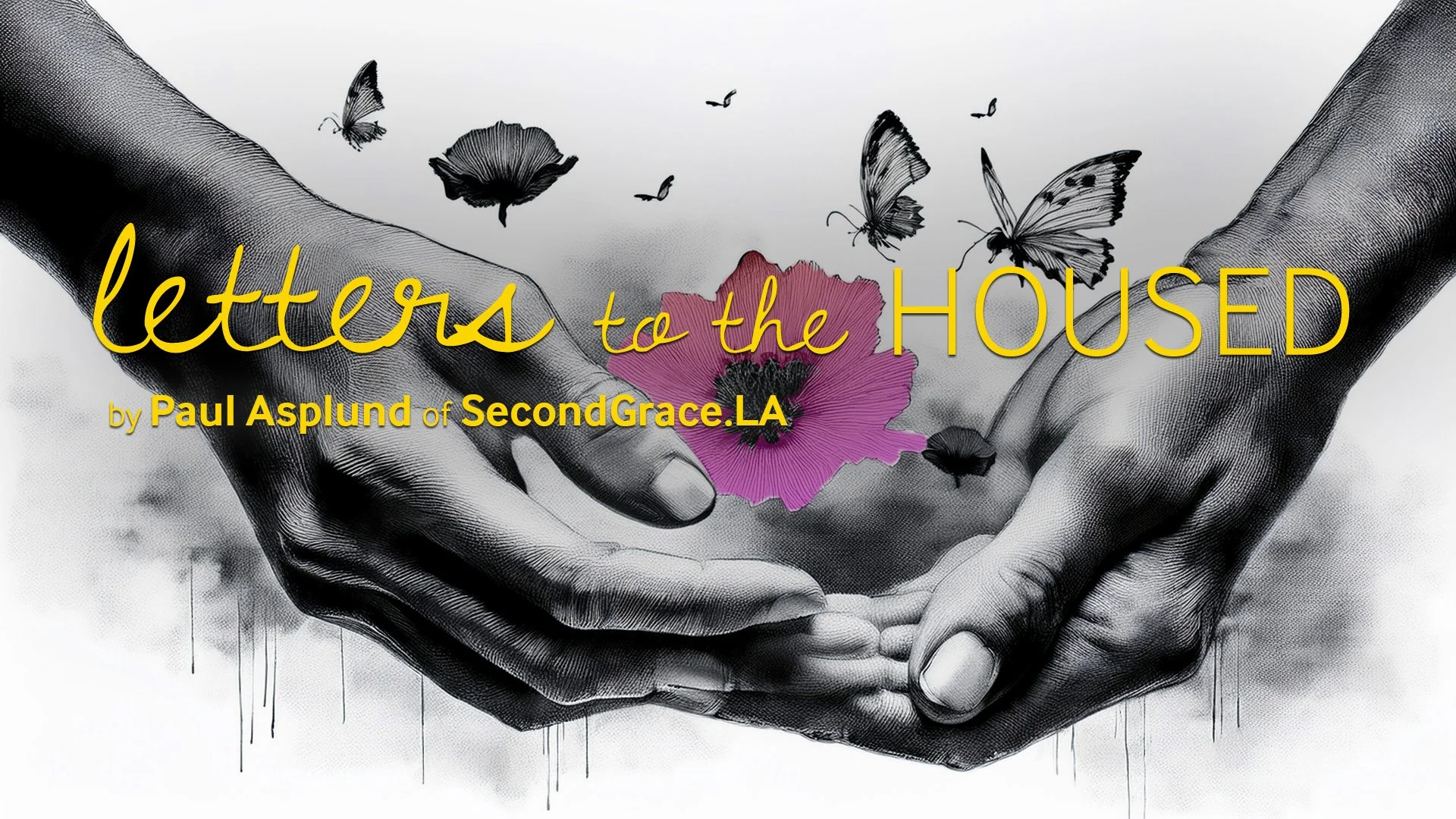
“We all rise to the level of care we're given.” Art by Delux Multimedia
How proximity, resistance, and spiritual surrender transform both server and served
Last week I talked about my personal struggles with answering my calling—how I resisted call after call to work at the margins, pulling back every time and choosing a safer road. Just like most people, I was worried about money, appearances, and security. I needed to work, that's a reality for most of us, and volunteering came and went as time allowed.
The Research on Resistance
Also like most people, the reasons I had for not volunteering boiled down to "changing circumstances" and lack of time (31%), but stress-related reasons are rising. We're all under more pressure these days, and political and economic chaos leave most of us fearing for our futures and that leaves too little energy for helping others. What the research doesn't fully capture is the spiritual cost of this cycle.
It's no surprise then that the national volunteer retention rate is around 65%—meaning 1 in 3 volunteers decide to leave. But behind these statistics are individual stories of people wrestling with the same tension between comfort and calling that I experienced for years.
When we feel a moral obligation but can't fulfill it, we experience "moral stress" that can actually impair our moral reasoning. The anxiety about not doing enough can paralyze us. We get stuck in a cycle of guilt and avoidance.
I Couldn't Look Away
In 2013, my ex got a job in San Francisco. We found an apartment near the corner of 9th and Market, where three neighborhoods converge—the Tenderloin, Civic Center, and SOMA. Twitter (now 'X') headquarters was across the street, Dolby was next door. Our building was essentially a tech dorm where people crammed into overpriced apartments.
Every morning, I walked out of that building onto a street shared by people on both ends of our economy—the best off and the worst off. It was challenging, leaving peaceful Los Feliz, but slowly I started to understand that all of these people were my neighbors, whether they had housing or not.
I had no choice but to see the people suffering around me. I couldn't look away. I couldn't retreat to the comfort of the life I'd left behind. The proximity was intense, the need too visceral, the call too persistent.
The path that took me from being a board member of a music group through to helping with the SoundVoice project at Hospitality House opened my eyes and eased me into doing something to help.
When I read the article about Doniece Sandoval, the founder of Lava Mae, her words spoke to me. She said, "It's not about the shower, it's about the dignity." My experience had primed me to take action.
Accepting that my own 'lived experience' could superpower my empathy, I just kept saying yes whenever an opportunity to help came along. I was "cracked open," and the years of fighting the call were over.
The Discoveries That Changed My Heart
What happened next changed everything I thought I knew about homelessness, about helping, about the people I was called to serve.
I discovered that 44% of people experiencing homelessness have jobs. They're working and still can't afford housing. The cost of housing has risen far faster than wages. In fact, wages had been stalled since the 70s. Most of us are worse off today than a worker was in 1970. I knew these weren't lazy people failing at life—these were my neighbors caught in an impossible economic equation.
I learned that 80% of homelessness is temporary—most people get back on their feet within six months. The people you see chronically on the streets are often dealing with deeper challenges that require sustained community support. This opened my heart to seeing crisis differently.
I witnessed how people experiencing homelessness responded when treated with dignity. When we called them by name, looked them in the eye, offered services without judgment, they blossomed. They reminded me that we all rise to the level of care we're given.
Each discovery was a spiritual teaching that could only come through sustained engagement, not drive-by charity or geographic distance.
Transformation
Let me tell you about SELAH (selahnhc.org), an organization I work with that embodies what happens when people answer the call. SELAH is staffed by 600 volunteers and just 3 paid employees. It was founded in 2017 by a handful of neighborhood volunteers and immediately resonated with the entire community.
These volunteers gather weekly to serve meals, provide services, and create community with our unhoused neighbors. Watching them serve has expanded my own spiritual education. And when I've had the opportunity to volunteer beside them, I've learned that I am surrounded by people who understand the spiritual benefits of helping others. They didn't answer the call for themselves, but they receive profound benefits regardless.
Research confirms this spiritual paradox: volunteering reduces depression, increases happiness, and extends life by helping us connect with others. When we serve, we discover we're not just helping "them"—we're healing ourselves.
Steve's story last week is a great example of personal growth through service. His situation was literally life-threatening, and he chose to act, to distract himself from the chaos in his own life. He wasn't in denial; he was in the midst of a discovery, a path that millions have chosen over the millennia, and the energy he put into the work paid off in ways that no one could have expected.
I've been told by many teachers that all it takes is a complete ego-crushing disaster in your life to get people to take any real action to change. But I've also learned about a gentler path, the one most of us are on, and that is the path of discovery, the 'unfolding of the lotus flower.' And these people are all around me.
Why We All Fight the Call
One out of 4 people say they don't volunteer because no one asked them—but deeper research shows it's about our psychology of resistance. Every volunteer I know has gone through this same wrestling match. The calling comes, we resist, we negotiate, we delay, we find excuses.
I've written often about the emotional mechanism that we sacrifice when we refuse to act to end the suffering around us. We shut off our empathy, and you can't just shut off a little empathy; it's either there or it isn't. In its place, we build a system of compartmentalizing our feelings, using our intellect to assign value to things: people, money, politics, religion, stripping all of them of their ability to change us, to shape us, to help us grow.
Those values choke out experience and replace it with another form of safety, that we won't be overwhelmed by the emotions we experience in life. It is a terrible thing to do to ourselves, and terrible to teach our children. But, as damaging as this approach can be in our lives, there's another more powerful approach that can change your life.
What I've learned working with hundreds of volunteers is that the spiritual growth happens as much in the resistance as in the surrendering. The wrestling itself is spiritual practice.
Research shows volunteer retention is complex—some need different motivations, different timing, different approaches. There's grace for the journey. Not everyone answers the call the same way or at the same time. The important thing is that we eventually stop fighting what our spirits crave.
The Spiritual Rewards
Research tells us volunteering helps us because humans are hardwired for the social connections made through service.
But the research can't capture the full transformation. When I finally stopped fighting the call and committed to this work, possibilities opened that I never imagined. I found my life's purpose, committed to helping however I could, and discovered the community I needed. I never knew life could be like this.
The expansion that comes from alignment with our deepest calling isn't just about feeling good. It's about becoming who we're meant to be. It's about finding the community that forms when we surrender to a purpose larger than ourselves.
What Happens When We Stop Fighting?
Studies show volunteers who serve 50+ hours per year are 40% more likely to continue than those serving 1-14 hours—depth of engagement transforms both server and served. There's spiritual growth here: the more you give, the more you receive. Not in a transactional way, but through the mysterious alchemy of genuine service.
When you stop fighting the call, you move from transaction to relationship, from helping "them" to healing "us." You discover that witnessing suffering doesn't break you—it breaks you open. And in that opening, authentic transformation becomes possible.
The people I thought I was helping became my teachers. The communities I thought needed fixing became the places I found healing. The service I thought was depleting me became the source of my greatest energy.
Your Journey Matters
If you're reading this and feeling the familiar tension between comfort and calling, know that you're not alone. This resistance isn't a character flaw—it's part of the journey.
There's a "volunteering inertia"—people who develop the habit of volunteering. The hardest part is the first yes. After that, service becomes not something you do but something you are.
The person experiencing homelessness down your street is waiting for you to stop wrestling. But they're not the only one. Your own transformation—the person you're meant to become—is also waiting on the other side of saying yes to what keeps interrupting your comfort.
What's your Bolivia? What's your geographic or emotional distance that lets you feel virtuous without getting close? What's your film project—the comfortable opportunity that keeps pulling you away from the call?
The Promise of Surrender
Last week, I wrote about hope as practice, drawing from Krista Tippett's wisdom about muscular hope that faces reality and refuses to accept that things have to be this way. This week, I want to add this: action completes the spiritual circle. Hope without action stays abstract. Action without hope becomes hollow.
But when hope and action come together through answering the call to serve, something transcendent happens. The pattern becomes: called, resist, surrender, transform, and get called again at deeper levels.
Your wrestling match matters. Resistance is part of the process. But the call is patient. It will keep interrupting your comfort until you finally say yes. And on the other side of surrender is the life you're meant to live and the person you're meant to become.
Next week I'll talk about some of the tools I use to keep my spirit intact. The prayers, meditations, and actions that bring balance into my life. Until then, stay safe, stay involved.
Not having shelter is not a personal failure. Together, we can create systemic solutions.
Ready to stop wrestling with your calling? Learn more about hope as practice and discover ways to answer your call to service at Second Grace LA.
Support our work: Fuel Hope with Second Grace LA
Connect with us: Links and resources